Author Archives: Ida

Hotel Industry Guest Issues: Hotel Guest Databases Such As “GuestChecker.com” Can Assist Hotel Management In Avoiding “Problem Guests”

“Many hotels now refuse guests based on their perceived or real behavior,” the story says. “For example many hotels in Florida and the Caribbean will not accept reservations for “Spring Break” groups. In Europe, hotels shy away from groups of British Soccer fans.”

Hotels are increasingly interested in swapping information with each other about “bad” guests, just like guests do with “bad” hotels using TripAdvisor, according to Hospitality Business News.

Most hotel guests, naturally, are good.

But when hotels do encounter guests who, for instance, call their credit card company to reverse a charge, assault another guest or even smoke in a non-smoking area, they just might wind up in the type of database maintained by GuestChecker.com.

  • What private information is kept on me?: The database contains a guest’s name, address, and phone number only, as opposed to more personal information such as credit-card number, race or religion. The information is kept in a database with “bank-level security” and is not available to the public.
  • Can hotel managers see the full list?: Hotel managers can’t scroll through the database to see who’s on it. They can only search for specific names and receive a “Match” or “No Match” result.
  • Is this a blacklist?: The company doesn’t call the database a “blacklist” because members “do not have the ability to advise other accommodation providers to refuse service for a guest.” It’s designed to help the next hotel “make an informed decision on how to best prepare for that guests arrival.”
  • What offenses land me on the list?: The company tracks five categories of behavior, with the worst being stealing, assault and non-payment. Lesser offenses would include actions such as smoking in non-smoking areas or using facilities such as the swimming pool or tennis court after hours. “Someone who accidentally knocks over a lamp and offers to pay for it should not be placed in the same category as someone who purposefully trashes a hotel room,” the company says.
  • Who reports me? One person per company or hotel can report a guest for an offense, and GuestChecker.com requires that person be a senior manager. “This stops any malicious reporting by the night watchman, for example,” the company tells Hospitality Business News.
  • How long will I be on the database?: A person could stay on the database for as long as four years.
  • For more:   http://travel.usatoday.com/hotels/post/2010/10/hotel-blacklist-how-do-hotels-define-a-bad-hotel-guest/127726/1

    Comments Off on Hotel Industry Guest Issues: Hotel Guest Databases Such As “GuestChecker.com” Can Assist Hotel Management In Avoiding “Problem Guests”

    Filed under Guest Issues, Management And Ownership, Risk Management, Theft

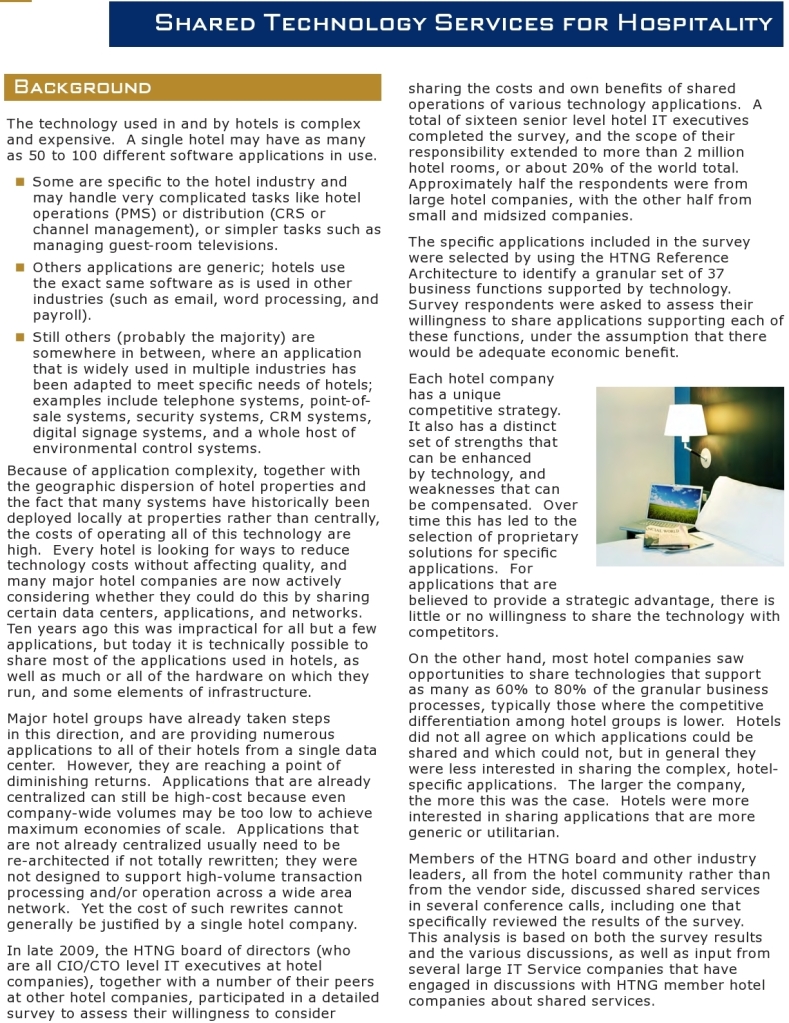
    Hospitality Industry Information Technology: Small- To Medium-Sized Hotel Owners Should Support A “Shared-Services” Model For Data And Call Center Services

    CLICK ON PICTURE TO READ ENTIRE "SHARED TECHNOLOGY REPORT"

    Comments Off on Hospitality Industry Information Technology: Small- To Medium-Sized Hotel Owners Should Support A “Shared-Services” Model For Data And Call Center Services

    Filed under Guest Issues, Liability, Maintenance, Management And Ownership, Training

    Hospitality Industry Health And Safety: Use Of “Improved Safety Practices” And “Older Workers” Contribute To A Decrease In Workers Comp Claims

    “Indemnity and medical severity for workers compensation claims continued to rise in 2009…

    “…the frequency of workers comp claims dropped 4% in 2009 following a 3.4% decrease in 2008. A downward trend in claims frequency that started in 1991 likely will continue through this year, NCCI said…”

    Factors such as increased use of robotics, improved safety practices and an aging workforce have contributed to the continuing frequency decrease, NCCI said.

    Complex claims, such as those related to carpal tunnel syndrome and lower-back issues, declined more than average during the past five years, NCCI added.

    Increasing claim costs, however, have partially offset the decline in frequency. Average indemnity costs increased about 4.5% in 2009 despite a decline in average weekly wages.

    “It remains to be seen whether changes in average wage and indemnity cost per claim will begin to converge in 2010,” NCCI said in the research brief.

    Average medical costs for workers comp claims rose 5% last year, the lowest increase in the past 15 years, NCCI said.

    For more:  http://www.businessinsurance.com/article/20101018/NEWS/101019945

    2 Comments

    Filed under Health, Injuries, Insurance, Labor Issues, Risk Management, Training

    Hospitality Industry Security Risks: Arizona City Hotel Ordinance Seeks To Curb Guests Who Pay In Cash And Withhold Registering Name In Attempt To Stop Crime

    The city is advancing a hotel-motel ordinance designed to track who stays in hotels, which police say will drive away prostitutes, drug dealers and other criminals who pay in cash and don’t give their name.

    Police are more interested in patrons who pay by cash or who check in at hotels that don’t require a name, Chief Frank Milstead said. Patrons who check in with a credit card aren’t trying to hide, he said.

    Mesa hotels will likely be forced to ask guests for an ID or some other proof of identity under a push to drive crime out of the city’s hotels.

    The city is advancing a hotel-motel ordinance designed to track who stays in hotels, which police say will drive away prostitutes, drug dealers and other criminals who pay in cash and don’t give their name.

    Police say other cities have fought crime with similar rules, but technology is posing a challenge as the city drafts an ordinance that requires a hotel to see a guest’s ID, verify license plate numbers and keep records for a year.

    Many hotels are converting to paperless registration, so it’s possible for guests to check in, pay by credit card and get a key without interacting with a hotel employee. Hotels don’t want to burden guests with showing an ID when a swipe of a credit card will identify who is checking in, said Robert Brinton, president of the Mesa Convention and Visitors Bureau.

    “We don’t want them to say it’s a hassle staying in Mesa,” Brinton said.

    Police are more interested in patrons who pay by cash or who check in at hotels that don’t require a name, Chief Frank Milstead said. Patrons who check in with a credit card aren’t trying to hide, he said.

    “Those aren’t the people we’re looking for,” Milstead said.

    The city’s Public Safety Committee agreed to move forward with the rules on Thursday. The proposal stems from police statistics in 2009 that showed 6 percent of all warrant arrests and 4 percent of all drug arrests were at hotels and motels. Just 10 hotels accounted for 49 percent of the warrant arrests and 64 percent of drug arrests. Police say regulation will greatly reduce the time they spend at hotels and allow them to fight other crime.

    A hotel-motel review board would oversee the rules, with some members being nominated by the hotel industry and some by the city. Hotels that don’t collect IDs and keep the information for a year could face fines of $250 to $2,500.

    Hotels support the rules, but say the ID issue needs to be resolved so it’s possible for guests to check in without showing an ID to a hotel when their identity has been revealed through a credit card payment. Also, Brinton said the six-page ordinance could probably be thinned to two pages to make the rules simple.

    For more:  http://www.eastvalleytribune.com/local/article_cdd2a84c-d7e3-11df-a6e4-001cc4c03286.html

    Comments Off on Hospitality Industry Security Risks: Arizona City Hotel Ordinance Seeks To Curb Guests Who Pay In Cash And Withhold Registering Name In Attempt To Stop Crime

    Filed under Crime, Guest Issues, Privacy, Theft

    Hospitality Industry Employee Risk Issues: Fair Labor Standards Act (FLSA) May Require Hotel Management To Pay “Overtime Compensation” To Employees Who Use Smart-Phones “After Hours”

    Under the FLSA, nonexempt employees are entitled to overtime compensation for “time spent working” beyond a 40-hour workweek. An employee does not even need to be required by the employer to work overtime but must merely do so for the employer’s benefit.

    While an employee’s off-the-clock smart-phone use may amount to only a few minutes here or there—and the FLSA provides an exception for “de minimis” overtime—legal experts say an employer’s liability can mount up in a class action.

    Moreover, the electronic records stored on smart phones may give an employee solid evidence on which to base an overtime claim.

         The department “has willfully violated the FLSA [Fair Labor Standards Act] by intentionally failing and refusing to pay Plaintiff and other similarly situated employees all compensation due them under the FLSA” for their after-hours Blackberry use, Sgt. Jeffrey Allen said in a suit filed in May as a proposed class action. A judge has to certify the case as a class action for it to proceed.

    The case is one of a handful nationwide in which employees have claimed overtime pay for smart-phone use—and apparently the first involving public employees. But lawyers say such cases are a clear warning to employers to put a smart-phone usage policy in place before they end up in potentially costly litigation. Smart phones “are very dangerous and risky for nonexempt employees to have if you’re worried about overtime,” says Jeremy A. Roth, a partner at San Diego law firm Littler Mendelson. 

    The case is one of a handful nationwide in which employees have claimed overtime pay for smart-phone use—and apparently the first involving public employees. But lawyers say such cases are a clear warning to employers to put a smart-phone usage policy in place before they end up in potentially costly litigation. Smart phones “are very dangerous and risky for nonexempt employees to have if you’re worried about overtime,” says Jeremy A. Roth, a partner at San Diego law firm Littler Mendelson.

    For more:   http://www.workforce.com/section/legal/feature/legal-static-over-issuing-smart-phones-workers/index.html

    Comments Off on Hospitality Industry Employee Risk Issues: Fair Labor Standards Act (FLSA) May Require Hotel Management To Pay “Overtime Compensation” To Employees Who Use Smart-Phones “After Hours”

    Filed under Labor Issues, Liability, Management And Ownership, Risk Management, Training

    Hospitality Industry Health Risk Management: Hotel Owners Must Establish Formal “Bed Bug Infestation Risk Management” Protocols For Preventing And Then Eradicating Infestations

    In certain cases, courts can even levy large judgments against hotel operators who rent rooms infested with bed bugs. In 2003, a federal appellate court awarded $372,000 in

    State inspectors have the authority to shut down an establishment that poses an "imminent health hazard" involving fire, flood, sewage backup, rodent infestation, bed bug infestation or "any other condition that could endanger the health and safety of guests, employees and the general public."

    punitive damages, roughly 37 times the compensatory award in the case, to a couple bitten by bed bugs while staying at a chronically infested Motel 6 in Chicago.

    Hotel owners and operators have faced periodic reports of bed bugs for decades, but a newfound public fascination with the problem, combined with the proliferation of websites dedicated to documenting bed bug outbreaks, has created a frenzy of media activity never before seen. Indeed, bed bug stories have been reported in the New York Times, Washington Post, Wall Street Journal, and many other local television and print outlets across the country. Stoking the traditional media’s interest in bed bugs is a rash of new online forums where travelers post the unsettling details of encounters with the pests.

    Much of the coverage seems sensational and overblown, but property owners and third party operators in the hospitality industry have to face the reality that the process of eliminating bed bugs from hotel rooms can be quite expensive and can lead to litigation and costly settlements. Additionally, reports of infestation on online travel sites like TripAdvisor and bed bug reporting sites like bedbugregistry.com and bedbugreports.com can cause significant reputational harm and loss of business.

    The good news for hospitality companies is that robust risk management practices, and the appropriate insurance and risk financing programs, can significantly mitigate the financial impact bed bugs can have on a hotel organization.

    Establishing formal risk management protocols around bed bugs is an important first step in minimizing the cost of infestation. Proactive steps for hotel organizations include creating a formal program to train housekeeping staff on spotting bed bugs, creating a policy on how to handle outbreaks or complaints and implementing regular pest control inspections.

    “Bed bugs are on our list of emerging issues facing the insurance industry, not only for hotels, but in the retail, apartment, and residential healthcare sectors,” noted Brian Gerritsen, Senior Director of Hospitality Business at Fireman’s Fund Insurance Company. “The recent increase in bed bug related claims has prompted us to become more proactive about the issue with our insurance customers.” Mr. Gerritsen’s team recently released an industry alert recommending that hotel operators take several actions to prevent potential infestations in guest rooms including:

    • Chemically treating mattresses and sealing them in plastic

    • Washing/drying bedding and towels regularly and daily if possible

    • Vacuuming cracks, crevices and other hiding places and sealing openings permanently so the bugs don’t have a place to hide

    • Having regular inspections and extermination services done by a qualified pest control contractor

    • Training and educating housekeeping employees to recognize the presence of bed bugs and immediately report any activity to the appropriate personnel

    For more:  http://www.pressreleasepoint.com/don039t-let-bed-bugs-bite-insurance-and-risk-management-perspective

    4 Comments

    Filed under Guest Issues, Health, Insurance, Management And Ownership, Risk Management, Training

    Hospitality Industry Risk Management: Hotel Owner Must Review “Employment Practices Liability Insurance” Coverage Language To Determine If It Covers “Wage And Hour” Lawsuits

     In Professional Security Consultants, Inc. v. United States Fire Insurance Co., Case No. CV 10-04588 SJO (SSx), Judge James Otero recently denied an EPL insurer’s motion to dismiss a complaint seeking coverage for costs incurred to defend and settle an underlying wage and hour class action.    

    The exclusionary language at issue was typical of such exclusions, barring coverage “for violations of the responsibilities, obligations or duties imposed by…the Fair Labor Standard Act…or similar provisions of any federal, state or local or foreign statutory or common law.”

    The underlying litigation alleged that employer Professional Security Consultants (“PSC”) violated various provisions of the California Labor Code, including wrongfully withholding overtime compensation. PSC was insured under an EPL policy issued by United States Fire (“US Fire”). US Fire moved to dismiss the coverage action on the basis of its “FLSA” (Fair Labor Standards Act) Exclusion. Citing California law regarding the breadth and scope of an insurer’s duty to defend, the court denied US Fire’s motion.

    The court noted that the policy’s definition of an “Employment Practices Wrongful Act” included “employment-related misrepresentations.” Comparing this policy language to the allegations of the complaint, the court emphasized the underlying plaintiffs’ allegation that PSC “[d]isseminated false information throughout [PSC’s] facilities and amongst [PSCs] employees, reciting that, under [PSC’s] labor policies and practices and under California law, the members of the Illegal Wages Class were not entitled to overtime compensation.” The complaint therefore alleged “employment-related misrepresentations,” triggering the potential for coverage under the policy.

    The court also rejected US Fire’s argument that there was no potential indemnity coverage because any amounts allegedly owed to the underlying Plaintiffs were not covered “Loss” under the policy. The court observed that the policy’s definition of covered Loss included “damages,” and that the underlying complaint expressly sought to recover damages.

    For more:  http://www.lexology.com/library/detail.aspx?g=75f1cf83-81de-43a4-8217-45ef67ed56ec

    Comments Off on Hospitality Industry Risk Management: Hotel Owner Must Review “Employment Practices Liability Insurance” Coverage Language To Determine If It Covers “Wage And Hour” Lawsuits

    Filed under Claims, Insurance, Labor Issues, Liability, Management And Ownership, Risk Management

    Hospitality Industry Guest Relations: “Problem Prevention” Is The Key To Customer Satisaction

    J.D. Power and Associates continues to observe that high levels of customer satisfaction are dependent on problem prevention, rather than problem resolution. That is not to say that service recovery is not required when a guest experiences a significant problem; however, it is more difficult to achieve the satisfaction level of those guests who don’t experience a problem in the first place, than for guests who experience problems that are eventually resolved.

    Across the industry, overall satisfaction is 144 points higher when guests did not experience a significant problem (781), compared with when they did (637). While there is a significant gap in satisfaction among the guests for whom the problem was resolved (705), compared with those for whom the problem remained unresolved (582), satisfaction still falls significantly below that of guests who did not experience a problem in the first place.

    While it is possible to so impress and exceed a guest’s expectations during recovery that they are more satisfied after recovery than if they never had a problem, these are rare occurrences.  We certainly would not advocate creating false problems in order to heroically swoop in and solve the problems for guests as a business model, but it does reinforce the important opportunity recovery represents. It makes a statement to guests about your brand and how you value their business.

    You might wonder, what are the most frequently occurring problems that guests cite?

    Across the industry, the top three problems guests cited are:

    1. Noise
    2. Hotel/room maintenance
    3. Heating ventilation and AC problems

    For more:  http://www.hotelnewsnow.com/Articles.aspx/4128/Guest-problems-better-prevented-than-resolved

    2 Comments

    Filed under Guest Issues, Labor Issues, Liability, Management And Ownership, Risk Management, Training

    Hotel Theft Risks: Florida Law Protects Hotel Ownership From “Most Liability” But Continued Guest Loyalty Demands A Secure Premises

    “…A… Naples, FL couple’s plans were shattered…when their motel room was burglarized shortly after they checked in and went to dinner. Everything of value — including electronics, cash, a designer purse and sunglasses, theme-park tickets, a passport, checks and Social Security cards — was gone when they returned…”

    They… filed a police report and demanded reimbursement from the motel for the $5,200 loss, but it was denied. A Florida law protects operators of public lodgings from most liability. Even when a hotel is negligent, a guest cannot recover more than $500 in most cases and $1,000 for jewelry or cash left with the hotel for safekeeping.

    In Orlando, where tourism is the engine that drives the economy, hoteliers are well aware of the need to protect their guests as much as possible, said Rich Maladecki, president of the Central Florida Hotel & Lodging Association.

    Most hotels have full-time security staff and work with law enforcement to root out problems, he said. Look for hotels with good lighting in hallways, at entrances and in parking lots, experts caution.

    For more:  http://www.orlandosentinel.com/features/law/os-law-and-you-hotels-tourist-rights-20100923,0,6507664.story

    Comments Off on Hotel Theft Risks: Florida Law Protects Hotel Ownership From “Most Liability” But Continued Guest Loyalty Demands A Secure Premises

    Filed under Crime, Guest Issues, Liability, Management And Ownership, Risk Management, Theft

    Hospitality Industry Employee Risks: Equal Employment Opportunity Commission (EEOC) Filed A Federal Lawsuit Against Hotel Owners Alleging “Pattern Of Racial Discrimination” In Hiring Hispanics Over Black Applicants

    A federal lawsuit filed Thursday by the Equal Employment Opportunity Commission against the owners of an Eastside hotel claims black housekeeping employees were fired after they complained that Hispanic workers were paid more for doing the same work.

    The suit, which alleges a pattern of racial discrimination against the hotel’s housekeeping staff and job applicants, also said the black workers were openly told they’d be fired and replaced because Hispanics cleaned better and complained less.

    The EEOC filed the suit claiming racial discrimination on behalf of five fired employees of the Hampton Inn, 2311 N. Shadeland Ave., plus a group of black applicants who sought jobs at the hotel.

    The EEOC suit also claims the hotel management destroyed employment records sought by the agency going back nearly two years. Incidents in the suit allegedly occurred from September 2008 to June 2009.

    The suit seeks back pay and reinstatement for the fired employees, and it seeks unspecified compensation for other blacks denied employment on the basis of their race.

    Hotel owners New Indianapolis Hotels LLC and Hement Thacker of Georgia could not be reached for comment. Attorneys in Indianapolis and Georgia, who formerly represented the hotel owner, declined comment.

    Though employment records have been destroyed, the EEOC estimated about 30 to 35 applicants sought work at the hotel and may have been denied work based on their race.

    For more:  http://www.indystar.com/article/20101001/LOCAL1803/10010388/1003/BUSINESS/EEOC-s-bias-suit-targets-hotel-on-Eastside

    Comments Off on Hospitality Industry Employee Risks: Equal Employment Opportunity Commission (EEOC) Filed A Federal Lawsuit Against Hotel Owners Alleging “Pattern Of Racial Discrimination” In Hiring Hispanics Over Black Applicants

    Filed under Labor Issues, Liability, Management And Ownership, Risk Management, Training