Author Archives: Ida

Hotel Industry Health Risks: Wisconsin Hotel Kitchen Is Source For Gastrointestinal Illness Suffered By Hotel Guests At A Fund-Raising Luncheon

A norovirus usually comes on suddenly, with 24 to 48 hours of exposure, with symptoms lasting one or two days, according to the Centers for Disease Control and Prevention. It can spread by eating food or drinking liquids or touching contaminated surfaces.

“…the Country Springs kitchen has been cleaned and kitchen staff have been informed about proper hand washing…”

Waukesha County health officials confirmed Monday that a norovirus is behind the outbreak of gastrointestinal illness reported by many of the 500 people attending a fund-raising luncheon last week at the Country Springs Hotel.

Julianne Klimetz, a county spokeswoman, said initial lab results confirmed the cause. In addition, investigators have confirmed that two people handling the food were ill at the time.

Health officials have not gotten reports of any secondary infection, in which someone who attended the lunch and became ill then spread it to someone else.

“It can be spread quite easily from one household member to another,” Klimetz said.

For more:     http://www.jsonline.com/news/waukesha/93988304.html

Comments Off on Hotel Industry Health Risks: Wisconsin Hotel Kitchen Is Source For Gastrointestinal Illness Suffered By Hotel Guests At A Fund-Raising Luncheon

Filed under Health, Liability, Training

Hospitality Industry Insurance: Directors’ And Officers’ Liability (D&O) Insurance Must Have “Dedicated Limits” Coverage To Cover Legal Defense Costs

“…the industry invented what’s known as dedicated limits–sometimes called difference-in-conditions–coverage. This coverage sits on top of and is excess to both the indemnity contracts and the company’s general D&O policy and is specifically intended to cover the situation where the company cannot or simply will not advance the director and officer his defense costs for matters with criminal law implications or otherwise…”

(From a RiskAndInsurance.com article)   Typically, directors and officers have an employment agreement, corporate by-law or separate contract that requires the company to “advance” (i.e., loan) them their legal defense costs should they become involved in a suit or investigation that could have criminal law implications for them. This is a director’s and officer’s first line of protection.

The programs then also typically insure directors and officers under D&O insurance policies. “Side A” of such policies insures them directly. “Side B” reimburses the company if it advances them money for defense costs under the company’s by-law or contract. And “Side C” covers the company’s fees if it is a defendant in a securities case.

Because all the coverages fall under a single limit, whatever is paid to the company under one side reduces the total coverage available. Plus, if there’s a big self-insured retention–a deductible–the directors and officers may have to pay it out of their pockets.

It’s for that reason (among others) that the industry invented what’s known as dedicated limits–sometimes called difference-in-conditions–coverage. This coverage sits on top of and is excess to both the indemnity contracts and the company’s general D&O policy and is specifically intended to cover the situation where the company cannot or simply will not advance the director and officer his defense costs for matters with criminal law implications or otherwise.

Most companies, however, do not have this coverage. Perhaps this complicated structure may have caused directors and officers in the past not to investigate their protection in great detail.

 For more:   http://www.riskandinsurance.com/story.jsp?storyId=395653638

Comments Off on Hospitality Industry Insurance: Directors’ And Officers’ Liability (D&O) Insurance Must Have “Dedicated Limits” Coverage To Cover Legal Defense Costs

Filed under Insurance, Liability

Hotel Pool And Spa Health And Safety: Pool Inspection Data Reveal That Failure To Maintain Disinfectant And pH Levels Are Serious Code Violations And Put Guest Health At Risk

“…hotel/motel pool inspections had the highest percentage of disinfectant level violations (….12.8%)..”

“…The most frequently reported type of recreational water illness (RWI) outbreak is gastroenteritis, the incidence of which is increasing…”

“…Of 111,487 inspections, 13,532 (12.1%) resulted in immediate closure because of serious violations (e.g., lack of disinfectant in the water)…”

Prevention of RWIs at treated venues requires pool operators to 1) maintain appropriate disinfectant and pH levels to maximize disinfectant effectiveness and 2) ensure optimal water circulation and filtration. Pool codes, promulgated by individual state or local public health agencies, govern pool operation.

Comments Off on Hotel Pool And Spa Health And Safety: Pool Inspection Data Reveal That Failure To Maintain Disinfectant And pH Levels Are Serious Code Violations And Put Guest Health At Risk

Filed under Health, Injuries, Liability

Hospitality Industry Health Insurance: Hotel Industry Must Comply With New Health Care Law Provisions For Automatic Enrollment, Waiting Periods And Coverage For Dependents

The hotel industry has some unique work-force characteristics that make the health-care reform law of particular interest, said Ron Kramer, partner with Seyfarth Shaw.

The abundance of part-time workers, seasonal workers and independent contractors, to name a few, will have a dramatic impact on how the hotel owners and managers accommodate the act’s many provisions, he said.

  • “There’s a provision that requires automatic enrollment for employers with 200 or more employees,” Kraft said. “That means they would have to automatically enroll employees.”
  • The waiting period for enrollment is being set at 90 days, which means many employers will have to shorten their current policies.
  • The act puts a prohibition on rescissions (cancellation of contracts) by insurance companies, except in cases of fraud. In the past, some insurance companies have been accused of scouring through a participant’s medical files upon huge claims to try to find some reason to rescind coverage.
  • By 2014, there will be no pre-existing conditions exclusions for any covered individuals.
  • While group health plans are not required to provide coverage for dependents under the act, they must extend that coverage to dependent children up to age 26 if such coverage already exists. Grandfathered plans must only extend that coverage if the dependent does not have any other employment-based coverage. By 2014, all plans will be required to provide coverage for dependent children.

For more:  http://www.hotelnewsnow.com/articles.aspx?ArticleId=3359&PageType=News&ArticleType=35

Comments Off on Hospitality Industry Health Insurance: Hotel Industry Must Comply With New Health Care Law Provisions For Automatic Enrollment, Waiting Periods And Coverage For Dependents

Filed under Health, Insurance, Legislation

Hotel Industry Health And Safety: Hotel Rooms Are A Haven For Germs And Potential Illnesses

 “A lot of times the cleaning crews will clean those glasses with the very same chemicals they’re using to clean your toilet.”

"There definitely can be hidden dangers in any hotel room, so you want to be smart,"

“…It might not just be germs lurking in your room. It could be infested with bedbugs. The problem is that you really can’t see them and they don’t just hide in the bed…”


Hotels, with their daily housekeeping, might seem like a haven from the dust, grime and filth of home. But be warned: germs can lurk in even the cleanest-appearing rooms. And you would be shocked where.

“…there is the TV remote control, probably the most touched item in the room. Not everybody is great about washing their hands and how thorough of a cleaning do you really think the remote gets?..”

For more:  http://abcnews.go.com/Travel/hidden-hotel-room-germ-magnets-tv-remote-water/story?id=10619191&page=1

Comments Off on Hotel Industry Health And Safety: Hotel Rooms Are A Haven For Germs And Potential Illnesses

Filed under Health, Insurance, Liability

Hospitality Industry Food Safety Training: Foodborne Illnesses Cause About 5000 Deaths And Over 200,000 Hospitalizations Per Year (Video)

[youtube=http://www.youtube.com/watch?v=PehFNG3qghI]

Foodborne illnesses are responsible for more than 75 million illnesses, more than 230,000 hospitalizations, and approximately 5000 deaths each year in the United States. In Part 1, we show you 3 types of contamination and how improper handling can allow them to become dangerous to your patrons.

The Central District Health Department provides a series of  Basic Food Safety videos focusing on the causes, dangers and prevention of foodborne illnesses.

Comments Off on Hospitality Industry Food Safety Training: Foodborne Illnesses Cause About 5000 Deaths And Over 200,000 Hospitalizations Per Year (Video)

Filed under Health, Liability, Training

Hotel And Resort Spa Health Risks: Massage And Foot Treatments Can Expose Guests To Infections And Health Risks

“…While most of today’s spas promise to restore, refresh, and renew — and some offer even more explicit health claims — they generally don’t warn you of the potential risks involved. But they do exist. Certain spa treatments can worsen chronic and acute health conditions. All spas can pose risks to the general public, particularly when operated in a state of uncleanliness…”

(From a CBSNews.com article)

  •  People with diabetes need to take extra precautions when getting foot treatments. “Any break in the skin, potentially from aggressive trimming of a callous or cuticle, can increase the risk of foot infections called cellulitis,” says Sharon Horesh, MD, an internal medicine doctor with Emory University’s department of medicine.
  • When it comes to massage, experts say that the degree of risk involved depends on the type of touch applied. “The most important adaptation for chronic disease, like cancer, is touch level,” says Kathleen Clayton, a licensed massage therapist and spokeswoman for the American Massage Therapy Association. 
  • “…all potential massage-goers to receive massages only from licensed massage therapists….”
  • “In the second and third trimesters, women should specifically seek a pregnancy massage therapist and avoid massage techniques that involve long strokes along the legs or pressure between the ankle and heels,” Horesh tells WebMD.  There’s good reason to heed this advice. “There’s always a chance that it might make the baby dislodge, or induce premature labor,” explains Clayton.

     http://www.cbsnews.com/stories/2005/12/15/health/webmd/main1128859.shtml

Comments Off on Hotel And Resort Spa Health Risks: Massage And Foot Treatments Can Expose Guests To Infections And Health Risks

Filed under Health, Injuries, Insurance, Liability

Hotel Industry Insurance: “Business Interruption Insurance” Benefits Are Dependent On Comprehensive Documentation Of Revenues And Profits

“…to recoup business interruption benefits from their insurance companies, we have found certain pieces of hotel data and documents to be extremely useful in our calculations of lost revenues and profits. The following is a partial list of reports (effective the day of the catastrophic event) that should be gathered and preserved by management:…”

  • Five-year history of competitive position reports (i.e. STR report), including current year-to-date.
  • Five-year history of your annual hotel financial statements, including current year-to-date.
  • Budgeted performance for the remainder of the current year.
  • Budgeted performance for the upcoming year.
  • Marketing plan for the current year
  • Marketing plan for the upcoming year
  • Capital improvement plan – current and future years
  • Guaranteed reservations and advance deposit activity.
  • Group contracts
  • Group booking pace for the next 10 years

(From a Hospitality.net article)   Once the historical performance data is gathered from the documents listed above, the next step is to estimate how the hotel would have performed if the catastrophic event had not occurred. To prepare this forecast, we utilize budget, marketing plan, reservation, and group booking information contained in the secured documents. In addition, we rely on the most recent forecast developed prior to the catastrophic event for the subject property’s market.

Using the market forecast as a baseline for future hotel supply, demand, and revenue conditions within the market for the projection period, we then estimate the market penetration of the subject property based on historical correlations to market performance. This provides us with estimates of the potential rooms revenue the subject property would have earned had the catastrophic event not occurred. From these estimates of hotel rooms revenue, we then prepare projections of net operating income (NOI) using historical hotel financial statements from the subject property, as well as data from our firm’s Trends® in the Hotel Industry database.

The calculation of lost business is derived from the difference between the performance of the subject property estimated under the “no catastrophic event” scenario, and the data from the actual performance of the hotel during the projection period. Estimates can be made for lost room nights, revenue, and hotel NOI.

http://www.hospitalitynet.org/news/154000320/4046598.search?query=hotel+insurance

Comments Off on Hotel Industry Insurance: “Business Interruption Insurance” Benefits Are Dependent On Comprehensive Documentation Of Revenues And Profits

Filed under Insurance

Hotel Pool Spa Health Risks: Legionaires Disease And Pontiac Fever Outbreaks Associated With “Poorly Maintained” Pools And Spas

“…a combined outbreak of Pontiac fever and legionnaires disease at a hotel in Oklahoma City, Oklahoma, associated with exposure to a poorly maintained hot tub. Ninety‐five percent of the mostly adolescent 107 ill people had Pontiac fever, and the remainder had legionnaires disease.”

Most aerosolized sources of bacterial‐contaminated warm water, including whirlpool spas, warm spring pools, decorative fountains, cooling towers, and industrial cleaning systems that use high‐pressure water, have been linked to outbreaks of Pontiac fever.

Because the hot tub had been heavily disinfected before analysis by investigators, the results of hot tub water cultures were negative, but the results of PCR for L. pneumophila were positive. As in many outbreaks, a minority (46%) of persons with Pontiac fever had elevated L. pneumophila antibodies.

http://www.journals.uchicago.edu/doi/full/10.1086/510394

Comments Off on Hotel Pool Spa Health Risks: Legionaires Disease And Pontiac Fever Outbreaks Associated With “Poorly Maintained” Pools And Spas

Filed under Health, Insurance, Liability, Training

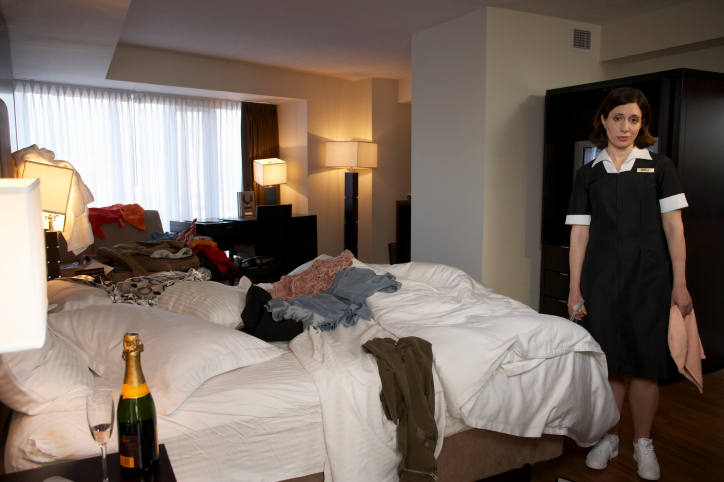
Hotel Industry Employee Injury Risks: Hotel Housekeepers Have “Higher Rates Of On-The-Job Injuries” According To Medical Journal

“…hotel employees — and especially housekeepers — have higher rates of on-the-job injuries, according to a report last year in the American Journal of Industrial Medicine…”

"...hotel employees — and especially housekeepers — have higher rates of on-the-job injuries, according to a report last year in the American Journal of Industrial Medicine..."

Housekeepers are prone to repetitive stress injuries from such continual work as changing sheets, washing bathroom floors and vacuuming, according to nine researchers who studied three years of government-required accident logs at five union-represented hotels.

(From a Chron.com article)    More surprising, however, is that Hispanic housekeepers had a proportionally higher rate of injuries than non-Hispanic cleaners, according to the study. The research didn’t address possible explanations for that.

The research was funded by the union Unite Here, which represents hospitality employees, but the problem also has captured the attention of the Occupational Safety and Health Administration.

It recently hosted a conference in Houston on health and safety issues facing Latino workers.

While OSHA doesn’t have a specific ergonomic standard — it was repealed by Congress in 2001 before it was scheduled to go into effect — the agency has the “general duty clause” as an enforcement tool. It requires that employers provide a safe and healthy place to work, Jordan Barab, deputy assistant secretary of labor for OSHA, said in a telephone interview.

http://www.chron.com/disp/story.mpl/business/sixel/7002756.html

4 Comments

Filed under Health, Injuries, Liability, Training